Lower data latency
Condition checks can run close to the machine without waiting for a round trip to a remote platform.
Resources / 2026 Industrial Automation
Industrial AI is moving closer to the machine. For roll-to-roll lines, the practical opportunity is to turn existing condition and process signals into earlier, more useful maintenance decisions.
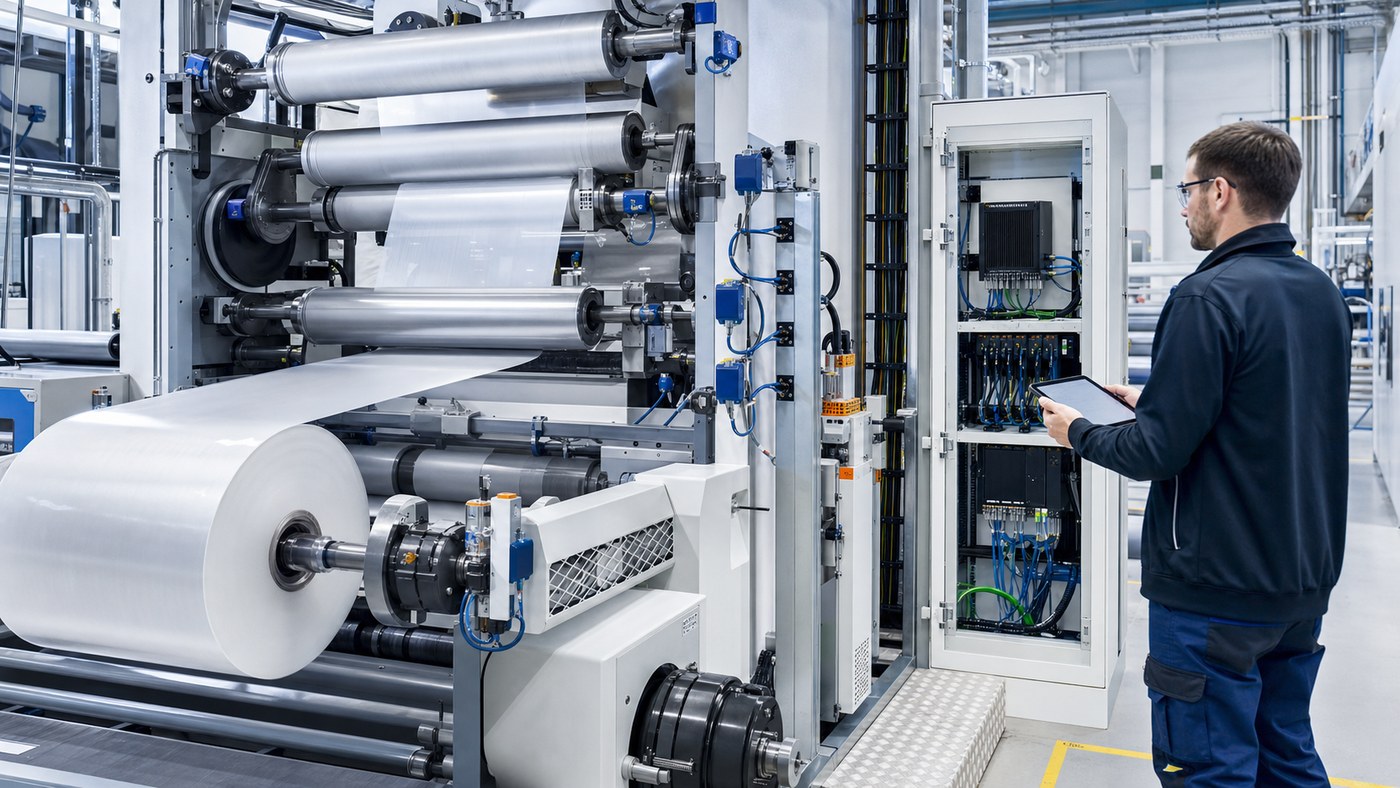
Local processing can evaluate machine signals near the equipment, support faster alerts and reduce the amount of raw production data sent to external systems.
Manufacturers continue to increase automation while asking for clearer returns from digital investments. PwC's 2026 global industrial manufacturing outlook reports that the share of manufacturers expecting key processes to be highly automated by 2030 rises from 18% to 50% among the executives surveyed.
At Hannover Messe 2026, Siemens announced expanded Industrial Edge data, AI and cybersecurity capabilities, including applications for predictive maintenance and visual inspection. The direction is important for OEM builders and converters: AI is becoming part of an industrial data architecture, not a separate demonstration running far from the production line.
Edge computing processes data on or near the factory floor instead of sending every raw signal to a remote cloud service. An industrial edge computer may collect selected PLC tags, drive values, sensor data and alarm history, then run rules or machine-learning models locally.
Condition checks can run close to the machine without waiting for a round trip to a remote platform.
Plants can send events, features or summaries upstream instead of continuously exporting every high-frequency signal.
Applications can be managed within defined industrial network, access and cybersecurity policies.
Edge AI does not replace the PLC, safety system or deterministic tension and web guide controller. Those systems continue to run the machine. Analytics observe patterns, identify deviations and support maintenance or process decisions.
A predictive-maintenance project should begin with signals that have a clear physical meaning. On a converting line, useful data may include actual and setpoint tension, tension error, line speed, roll diameter, drive torque, brake or clutch command, web position, guide correction, actuator command, motor current, alarm codes and production state.
Additional condition sensors can add bearing vibration, temperature, pressure, air quality or cabinet environment data. Material type, web width, job recipe and operating mode provide context. A tension deviation during acceleration is not necessarily a fault, so the model must know whether the machine is starting, running steadily, changing rolls or stopping.
Changes in vibration, temperature or drive load can support inspection before a bearing problem creates web marks, drag or an unplanned stop.
Rising correction frequency, longer travel time or repeated hunting may indicate mechanical looseness, sensor contamination, poor alignment or actuator wear.
Increasing error, output saturation or calibration drift can flag a load cell, brake, clutch, drive or mechanical issue for engineering review.
The goal is not to label every deviation as failure. The best use cases connect an observable pattern to a maintenance action: inspect a bearing, clean a sensor, verify calibration, check air pressure, review brake response or schedule a controlled component replacement.
Predictive results are only as useful as the underlying data. Tags need consistent names, units and timestamps. Machine states must be recorded so normal startup transients are not compared with steady production. Maintenance records should identify what failed, what was replaced and whether the intervention solved the problem.
Start with a baseline dashboard and deterministic limits. Trend tension error, actuator duty, drive load and key alarms by product and operating state. This often exposes missing sensors, calibration problems and inconsistent event definitions before a machine-learning model is introduced.
Production control should remain deterministic and fail-safe. Predictive analytics can recommend action, but safety interlocks and critical motion control must stay within validated control systems. Network architecture should define allowed data flows, user roles, software update procedures and recovery plans.
For legacy equipment, begin with read-only data collection where possible. Review vendor support before adding gateways or changing controller communications. A successful edge project improves visibility without making the machine harder to service or introducing an undocumented path into the OT network.
Verify tension, position, speed and condition signals; correct calibration and timestamp problems.
Combine signals with machine state, material, recipe, alarm and maintenance history.
Run one monitored pilot, compare alerts with real inspections and quantify useful lead time.
Only scale after the plant can explain why an alert matters and how it changes maintenance work. A small, trusted model on one machine creates more value than a large dashboard that operators and technicians ignore.
Reliable analytics begin with stable machine-level sensing and control. KRD tension controllers, load cells, web guide controllers, sensors and actuators support the physical process signals that engineers may choose to integrate with a PLC or plant data system. Communication requirements should be confirmed for each product and project architecture.
No. The controller or PLC continues to run the machine. Edge analytics use selected data to identify patterns, support diagnosis and provide maintenance information.
Start with a signal tied to a costly and repeatable problem, such as bearing vibration, tension-loop saturation, actuator duty or drive load. The maintenance action must also be clearly defined.
Not always. Edge systems can process data locally, although centralized dashboards, fleet comparison, model management or long-term storage may use plant servers or cloud services.
It depends on the failure mode and operating cycle. Useful datasets need normal production, relevant machine states and verified examples of the condition being detected, not simply a large volume of unlabeled data.
Share your material, web width, line speed, tension or guiding challenge and automation interface. KRD can help match the sensing and control components at the machine level.