
Unwind roll
The roll radius decreases, shaft speed rises and the brake or regenerative drive must continuously reduce the torque needed for constant web tension.
Resources / Tension Control Guide
Roll diameter changes throughout every winding cycle. A stable tension system must adjust speed or torque as the unwind roll shrinks and the rewind roll grows.
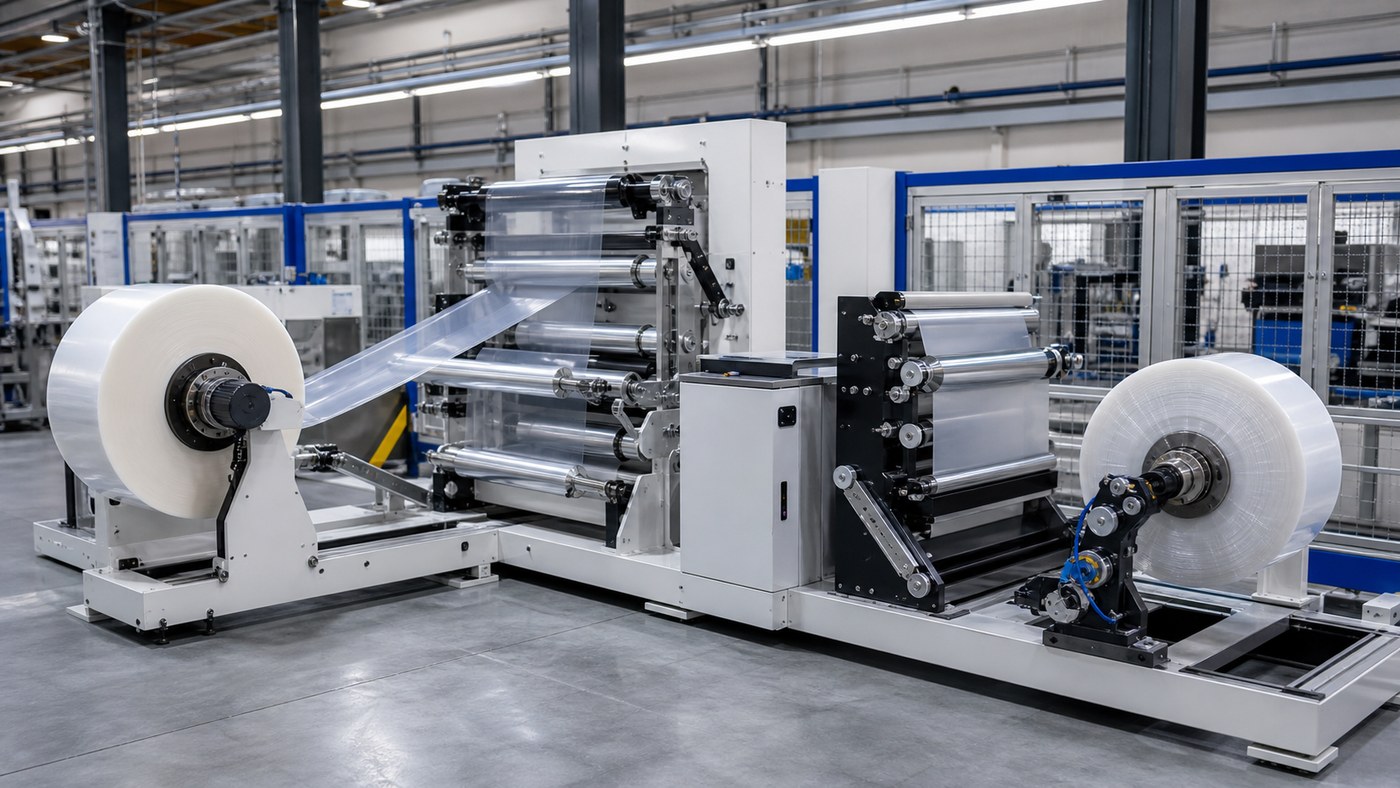
A fixed brake or drive output cannot hold the same web tension from core to full roll. The control loop must compensate as roll radius and inertia change.
In an ideal centre-winding system, shaft torque is related to web tension multiplied by roll radius. A larger radius therefore needs more torque to produce the same web tension. At a constant line speed, shaft speed moves in the opposite direction: the shaft turns faster near the core and slower at full roll.
Real machines add bearing friction, brake response, drive dynamics, roll inertia and acceleration torque. That is why an unwind or rewind that looks stable at steady speed may still show tension spikes during startup, deceleration or an emergency stop.
The roll radius decreases, shaft speed rises and the brake or regenerative drive must continuously reduce the torque needed for constant web tension.
The roll radius increases, shaft speed falls and the winding drive or clutch must supply more torque while protecting finished roll quality.
Driven nips isolate tension zones so coating, printing, inspection or slitting sections can operate at the force their process requires.
An unwind zone normally extends from the parent roll to the first driven nip. Tension can be created by a pneumatic brake, magnetic powder brake or controlled motor drive. A manual regulator may be sufficient for a simple, forgiving process, but changing diameter means the operator must keep correcting output.
Automatic systems use diameter calculation, ultrasonic diameter measurement, a dancer or load-cell feedback. A closed-loop controller compares measured tension with the setpoint and changes brake or drive command to correct the error. Soft-start logic can reduce abrupt brake output when the line begins moving.
A rewind zone runs from the last driven nip or process section to the winding shaft. A drive or clutch creates winding torque. Closed-loop feedback is useful when film, foil, paper, label stock, nonwoven or battery material must be wound consistently across changing speed and diameter.
Mechanical alignment and web guiding still matter. Tension control cannot correct a bent shaft, misaligned roller or lateral web wander, and a web guide cannot repair poor roll hardness caused by unstable winding tension.
Constant tension is not always the best rewind setpoint. As layers build on a roll, excessive internal stress can create crushed cores, starring, telescoping or blocking. Taper tension gradually reduces the setpoint as diameter increases, allowing the outer layers to be wound with less tension than the layers near the core.
Taper percentage is application-specific. Material stiffness, thickness, friction, winding method, nip pressure and finished-roll requirements all influence the correct value. Start with a conservative machine or material recommendation, then validate roll hardness and downstream performance rather than copying a setting from another substrate.
Uses calculated or measured diameter to schedule torque. It is practical for stable mechanics and moderate accuracy but does not directly measure web force.
Uses dancer position as feedback and provides some material storage. It can absorb short transients but needs space, correct loading and low-friction mechanics.
Measures web force directly at a sensing roller. It supports accurate closed-loop control when the load cells, wrap geometry, amplifier and controller are correctly sized.
For a more detailed comparison, see closed-loop versus open-loop tension control and review the available web tension sensors.
Check diameter compensation, torque scaling, feedback calibration and whether rewind taper is appropriate.
Review acceleration rate, roll inertia, soft-start logic, brake release and controller response.
Inspect taper settings, nip loading, alignment, core condition and cross-machine tension profile.
KRD can match controllers, feedback sensors and torque actuators to the control zone and machine interface.
The torque needed for a given web tension changes with roll radius. Without diameter compensation or closed-loop feedback, a fixed brake output produces different tension as the roll shrinks.
Unwind control restrains the supply roll with a brake or drive. Rewind control applies winding torque with a drive or clutch while managing finished-roll quality.
No. Taper is most useful when constant tension creates excessive internal roll stress. The correct setting depends on the material and winding process.
They solve different mechanical and control needs. Load cells directly measure force, while dancers measure position and can provide short-term web storage. Required accuracy, space and line dynamics determine the better option.
Share your web material, width, tension range, line speed, core and full-roll diameter, and available brake or drive interface. KRD can help identify a practical controller, sensor and actuator combination.